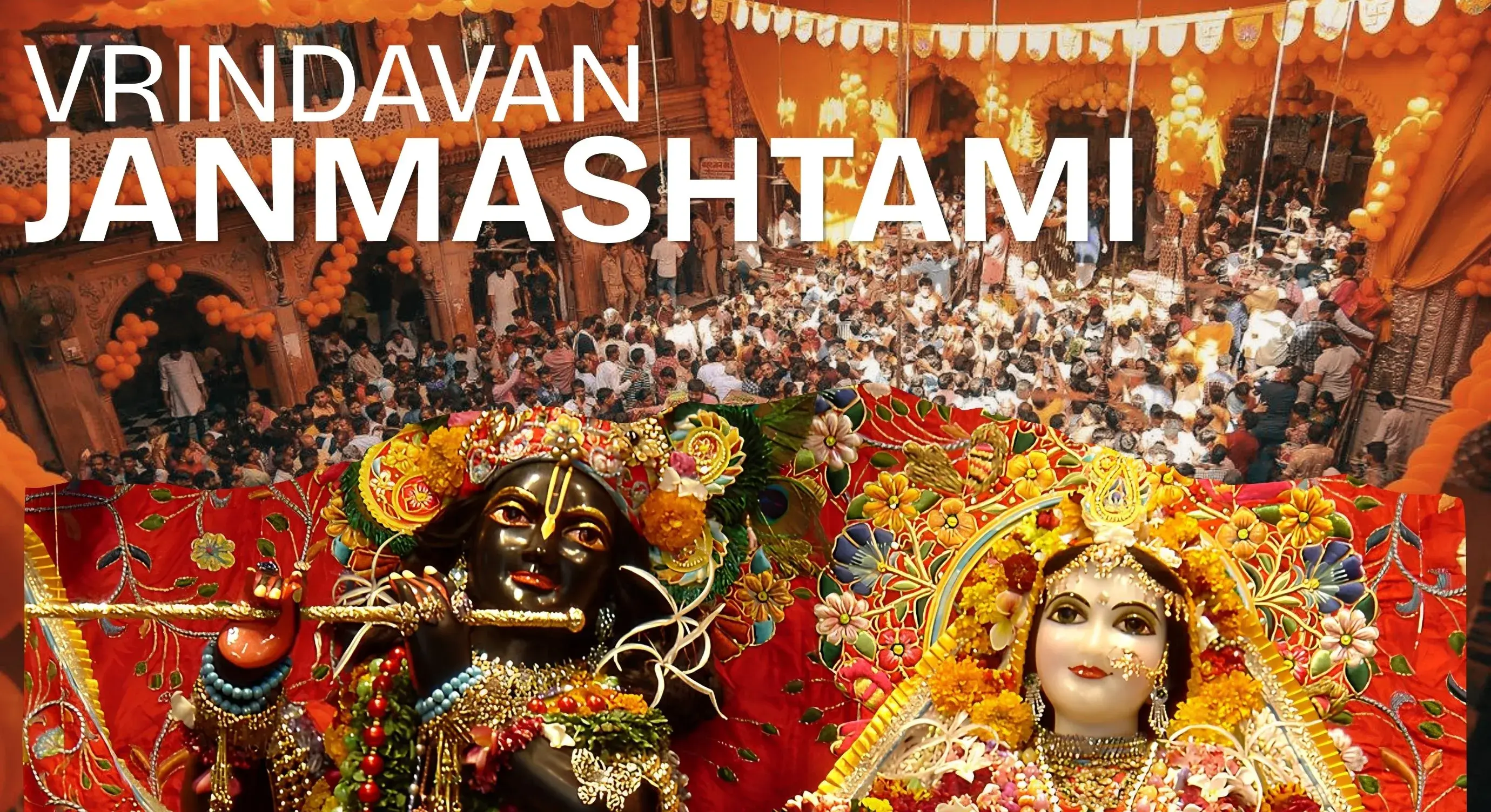
The Janmashtami celebration in Vrindavan will take place on 4 September 2026, on the Ashtami Tithi of the Krishna Paksha in the Bhadrapada month. Braj Bhoomi is where Lord Krishna spent his lovely childhood by stealing butter, killing demons, and performing Raas Leela with the Gopis under moonlight, so celebrations here are truly ecstatic.
Vrindavan, Mathura, and Gokul are best for experiencing the unique, devoted celebration of Lord Krishna's birth. The occasion here feels like a personal connection with the divine, with every temple depicting the Lord's pastimes through attractive decorations and performances.
So, through this article, we’ll look at how Krishna Janmashtami is celebrated in Vrindavan and see the best spots you can visit during this time, so that if you are planning to go there, you know exactly where to go and how to make the most of it.
Why Janmashtami in Vrindavan Feels So Special?
Vrindavan is also known as the divine forest of Radha Krishna and is described as the place where Lord Krishna spent most of his childhood playing with his friends and spending time with Srimati Radha Rani. Moreover, due to this deep connection, at the Krishna Janmashtami celebration in Vrindavan, you can feel the difference of the occasion from anywhere else in the world, as devotees here not only celebrate the birth but also feel the energy of the place where the Lord actually grew up.
Devotees observe full day fast on Janmashtami, and as the festival comes close, the entire town is transformed: temple courtyards begin to glow with fairy lights, and the constant sounds of Kirtan fill every corner of the town, even at night, making it a fascinating experience for devotees. You will also see various performances performed by different professional artists, all with utmost devotion, making it the most spectacular celebration.
If you want to witness this scenic buildup without peak crowds, arrive 4-5 days early, which will give you a good balance of festive atmosphere and manageable crowds.
How Is Janmashtami Celebrated in Vrindavan?
Janmashtami festival in Vrindavan consists of several playful and engaging activities listed below one by one:
1. Jhankis and Temple Decorations:
About a week before the festival arrives, public places across Vrindavan begin setting up visually appealing Jhankis depicting some of the greatest scenes from Lord Krishna’s life, such as his birth in Mathura prison, his childhood pranks with the gopis, lifting the Govardhan parvat, and playing the flute near the Yamuna River.
These displays, often decorated with lights, diyas, and lookalike figures, will connect you with Lord Krishna throughout the festive days. You can visit major temples like Banke Bihari, ISKCON, Prem Mandir, Radha Raman, and Radha Madan Mohan, which are decorated with fresh marigold, jasmine, and rose flowers, and their artworks reflect the divine bond between Lord Krishna and Radha.
You can get the best views of these jhankis in the evening, once the lights are switched on; most of the temples keep them on display through the night for all the devotees.
2: Raasleela and Krishna Leela Performances:
Raasleelas and Krishna Leela performances are mesmerizing, heart-filling celebrations of Krishna Janmashtami in Vrindavan, where various artists perform dance and drama, depicting the playfulness and love of Lord Krishna with Radha and the gopis under the moonlight during Maha Raas Leela.
You and your family will love this activity more than anything else, as it blends local folk theatre, devotional music, and classical Indian dance forms like Kathak and Manipuri. These Raasleelas are usually performed in the local Braj language, which is very similar to Hindi and therefore will be easier for you to understand and feel.
Moreover, you will find these performances in the courtyards of most loving temples and at dedicated Raas Leela grounds across Vrindavan, especially in the evenings leading up to Janmashtami. Most of them are free and open to the general public; they are free to watch, and no advance booking is required.
3. The Midnight Abhishek and Janmotsav:
On the day of Janmashtami, as the clock strikes 12 at night, you can witness the grand bathing ritual that is performed by pouring panchamrit, a mixture of milk, curd, ghee, honey, and sugar. The conch shells are blown, temple bells ring continuously, and devotees chant aloud “Nand ke Anand Bhayo, Jai Kanhaiya Lal ki,” marking the appearance of the Lord, just like the Brajwasis did around 5,000 years ago.
After the abhishekam, the Lord is adorned with new ornaments and dressed before being placed in the decorated Jhula (Cradle). You will also see that several devotees then, turn by turn, come, singing devotional songs, and offer their heartfelt devotion to the Lord by swinging the cradle, a ritual considered deeply auspicious, as it symbolically marks the Lord's birth. You can also perform this seva and earn the blessings and the divine opportunity to welcome the Lord yourself.
Also, if you want to experience the abhishekam up close, it is best to be inside the temple by 10 to 10:30 PM, as after that, entry becomes harder as the crowd grows.
4. Prasad Distribution:
After the midnight ritual, you can have the blessed panchamrit, the holy drink containing the Lord’s divine essence. Moreover, temples like Shri Banke Bihari, ISKCON Vrindavan, and Shri Radha Raman distribute the grand bhog prasadam to all the devotees; you can enjoy the grand offering and can avail the merit of the Lord’s lovely bhog.
You will see long queues of devotees, both locals and visitors, so you will need to wait patiently through the night just to receive this prasad, turning the divine experience into joy and gratitude. You can also carry a small portion of this sanctified prasadam home and share it with your loved ones who were unable to attend the Janmashtami celebration in Vrindavan.
5. Nandotsav:
Nandotsav happens the next morning after Janmashtami. You will see several toys, candies, clothes, sweets, and small trinkets thrown among devotees in the temple sanctums as sacred prasad, marking the same generosity shown by Nanda Maharaja in gratitude for the Lord's birth.
Most temples begin their Nandotsav celebrations early in the morning, around 6-7 AM, so it’s worth arriving a little early to get a spot. Remember that all the temples are filled with crowds from morning to night, with continuous devotional music and devotees engaging in playful color- and curd-throwing rituals known as DadhiKandha, a tradition that began 5,000 years ago among Brajwasis in celebration of Lord Krishna’s birth.
Janmashtami Celebration in Mathura
In Mathura, you will witness that the festival of Janmashtami is celebrated a little differently compared to Vrindavan, as it is the very place where Lord Krishna was born in a prison cell. Here, you will find that Jhulanotsav and Ghatas are widely celebrated in every home and temple in the city.
Local people put out swings in their house gardens, decorated with flowers and fairy lights to welcome Lord Krishna. You can also visit the Krishna Janma Bhoomi Mandir, where the celebration takes place in a transcendental way, and devotees believe that any wish made while swinging the cradle comes true on the day of Janmashtami.
Other famous temples, like the Shri Dwarkadhish temple, also host grand celebrations in which the Lord is not perceived as a newborn child but as the King of Dwarka. Deities in this temple are offered new clothes every hour on special occasions for special Jhanki darshans, adding a royal touch to overall Janmashtami celebrations in Mathura.
Traveling is very easy: you can go from Vrindavan to Mathura by auto or e-rickshaw in about 20-30 minutes, making it convenient to visit both locations on the same day.
Famous Temples for Janmashtami Celebration in Vrindavan
Let’s look at the best places to visit in Vrindavan during Janmashtami:
1. Banke Bihari Temple:
- The temple is home to the only “moving eyes” deity of Lord Krishna, worshipped in the reclined form as Thakurji.
- On Janmashtami, the temple performs Mangala Aarti only once every year, making it one of the most sacred darshans for crowds to attend.
- Timing for Janmashtami: Check the official website bihariji.org
2. ISKCON Vrindavan (Sri Krishna Balaram Mandir):
- Draws the largest international devotees across the world, among all the Krishna temples in Vrindavan.
- On Janmashtami, 24-hour nonstop kirtan and bhajan run from early in the morning, followed by the grand abhishekam.
- Timings for Janmashtami: Check the official website iskconvrindavan.com
- Since the celebration at ISKCON Vrindavan temple continues for 24 hours non-stop, many devotees prefer to arrive in the evening and stay till the midnight abhishekam.
3. Prem Mandir:
- Known worldwide because of its magnificent marble architecture, nightly musical fountain, and light show.
- On Janmashtami, the temple darshan timings are extended till midnight, with a special jhulan ceremony, and the temple is adorned with vibrant festival decorations.
- Timings for Janmashtami: Check the official website premmandir.org.in
- If you want to see the fountain show and midnight celebration, plan your visit around evening 7:00 to 7:30 PM.
4. Radha Raman Temple:
- Houses a 500-year-old self-manifested Saligram deity, one of the most divine forms of Lord Krishna, worshipped here.
- On Janmashtami, as per temple traditions, it is the only place in the world where the festival is celebrated at dawn rather than midnight, as the deity manifests at dawn, reflecting a very different way Janmashtami is celebrated in other temples of Vrindavan.
- Timings for Janmashtami: Check the official website shriradharaman.com
- Since it is the only temple that celebrates Janmashtami at dawn rather than midnight, it is a good option if you want to witness the celebration here without staying up all night.
5. Radha Vallabh Temple:
- Devotees here worship the Lord with Sakhi- Bhav (Braj Gopis), seeing themselves as the companions of Srimati Radha Rani rather than direct devotees of the Lord.
- On Janmashtami, the celebration carries the same emotional sakhi tone; devotees immerse themselves in Sri Radha’s perspective, making the atmosphere a little tender.
- 2026 Timings for Janmashtami: Check the official website radhavallabhmandir.in
- This temple sees fewer crowds than the Banke Bihari or ISKCON temples, making it a good choice if you prefer a quiet darshan.
How Many Days Do You Need for Janmashtami in Vrindavan?
Deciding your stay is very important at peak festival time, so here is a quick breakdown for you.
1 Day (Same Day):
If you are traveling from nearby cities like Delhi or Agra and have limited time, a single day is enough to explore the town. You can first visit the Banke Bihari temple, then, on the way, cover ISKCON and Prem Mandir, and if you still have time, enjoy the evening Raas Leela performances.
2 Days:
2 days are best for fully exploring the city and enjoying the midnight abhishkam experience. The next day, you can also see the Nandotsav celebration, and in the afternoon you can go to Mathura to see the festive celebrations there also.
3 - 4 Days:
If you have 3-4 days, try to arrive one or two days before the festival so you can see the decorations and other activities in a smaller crowd. On Janmashtami, celebrate in Vrindavan, and spend the next days exploring nearby towns like Nandgaon, Gokul, Barsana, and Mathura. This option works best if you are traveling with your family, as you will have enough time to see different arrangements at popular places.
Tips for Visiting Vrindavan During Janmashtami
If you are planning to attend this year’s Krishna Janmashtami in Vrindavan, then you should consider some things before going to Braj:
- Given the large crowd, it is advisable to arrive 1-2 days before the festival to settle in.
- Visit the major temples, such as Prem Mandir, Sri Sri Krishna Balaram Mandir, and Radha Raman Temple, during the daytime.
- If you plan to attend the early-morning Mangala Aarti at Banke Bihari Temple, plan your evening and rest accordingly.
- Avoid bringing elderly people, small children, or anyone with disability, as it can be difficult for them to be in huge crowds at peak celebration time.
- Carry basic luggage, avoid wearing expensive jewelry, and keep your belongings safe.
- Protect smartphones and glasses from local monkeys, and keep juice tetra packs if something happens.
- Do not take cars inside, as it will be impossible to move them there; try to travel by e-rickshaw or walk through the lanes.
- If you do not book a place in advance, look for hotels or dharamshalas in Vrindavan or nearby Mathura, because accommodations fill up much faster on Janmashtami.
- The nearest railway station is Mathura Junction, about 12-15 Km away, and the nearest airport is Agra, roughly 65 Km from Vrindavan; plan your travel accordingly if traveling from outside the region.
Conclusion
Celebrating Krishna Janmashtami in Vrindavan temples is purely a once-in-a-lifetime experience, which, as a devotee, you should probably attend. From grand decorations and ecstatic kirtans to sacred midnight rituals, everything here purely reflects the essence of Lord Krishna.
Vrindavan Janmashtami festival perfectly offers devotees the opportunity to connect with the divine through different celebration activities and surroundings where the Lord has spent his childhood.
FAQs
What makes Janmashtami celebrations in Vrindavan different from the rest of India?
Vrindavan Janmashtami celebrations are uniquely focused on Lord Krishna’s childhood leelas rather than just celebrating the birth. The entire town engages in the 10 days before the festival, featuring different traditional dramas, devotional singing, and vibrant decorations across different temples.
Which temple in Vrindavan is best to visit for Janmashtami?
The Banke Bihari temple offers the most vibrant visit on the day of Janmashtami, famous for its deity and the once-a-year mangla aarti ritual performed only on Janmashtami day.
Is it a good idea to visit Vrindavan during Janmashtami, given the crowds?
Visiting Vrindavan on the day of Janmashtami is truly an unforgettable experience, but it is not recommended if you do not like massive crowds, long waiting queues, and intense physical activity.
Why do ISKCON Janmashtami celebration dates differ?
ISKCON follows strict Vaishnava Panchang calculations, which differ from other Hindu calendars, so ISKCON Janmashtami celebrations are sometimes held the next day.
Offer Seva This Janmashtami
Your offering supports the sacred Janmashtami celebrations and devotional service to Shri Krishna.
Share this article
Help spread the joy and devotion of Janmashtami with others.