

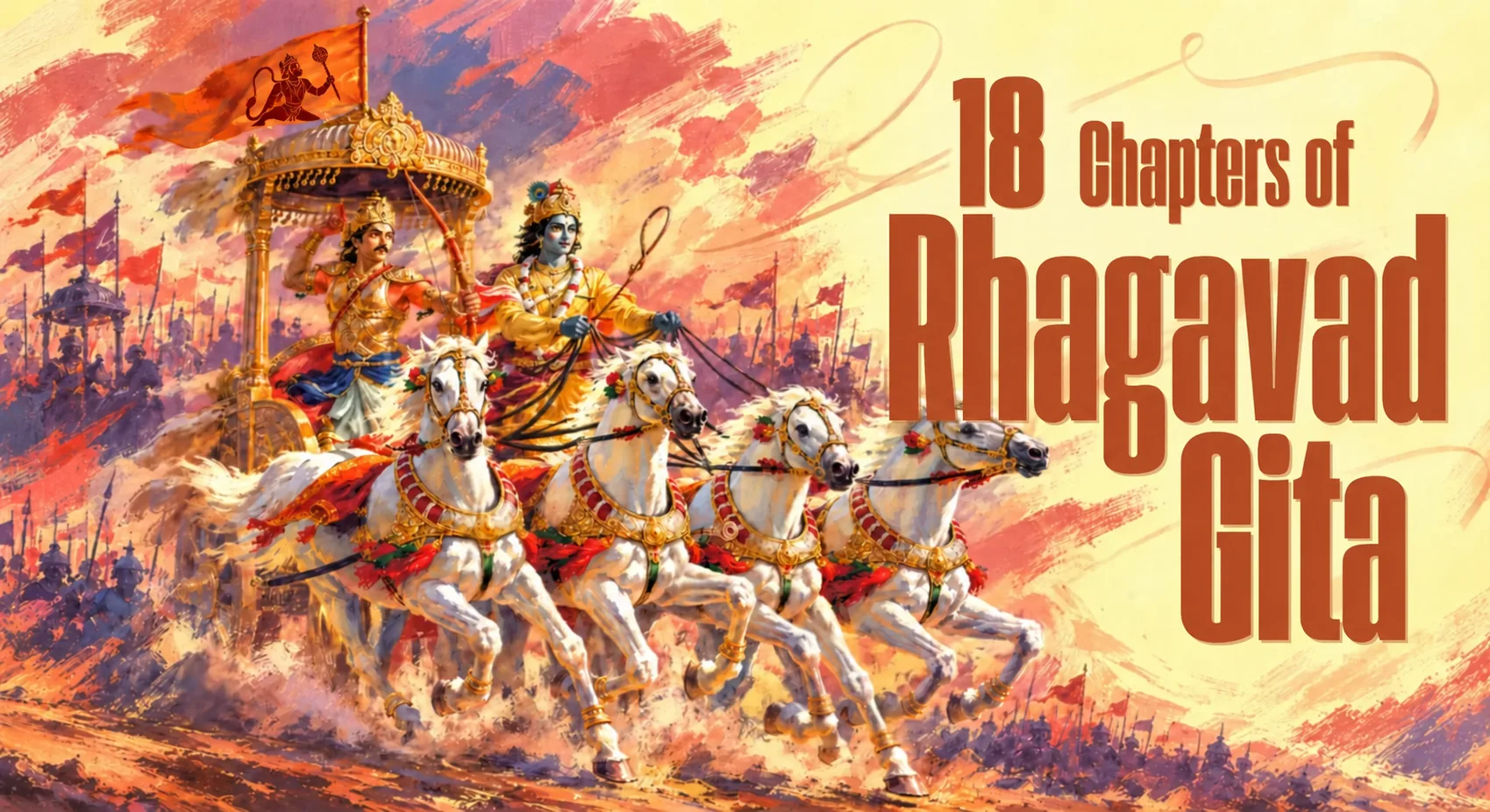
The Bhagavad Gita, also known as “the Song of God”, is the conversation between Lord Krishna and Arjuna on the battlefield of Kurukshetra. It consists of 18 chapters and 700 shlokas. Bhagavad Gita begins with Dhritarashtra asking Sanjaya what is happening on the battlefield, followed by Lord Krishna answering Arjuna’s questions about his duty and the purpose of life.
Bhagavad Gita Chapter Names
- Observing the Armies on the Battlefield of Kurukshetra
- Contents of the Gita Summarized
- Karma-yoga
- Transcendental Knowledge
- Karma-yoga: Action in Krishna Consciousness
- Sankhya-yoga
- Knowledge of the Absolute
- Attaining the Supreme
- The Most Confidential Knowledge
- The Opulence of the Absolute
- The Universal Form
- Devotional Service
- Nature, the Enjoyer and Consciousness
- The Three Modes of Material Nature
- The Yoga of the Supreme Person
- The Divine and Demoniac Natures
- The Divisions of Faith
- Conclusion: The Perfection of Renunciation
Bhagavad Gita Chapter-wise Summary
Chapter 1 Summary: Observing the Armies on the Battlefield of Kurukshetra
Dhritarashtra asked Sanjaya, "What did my sons and the sons of Pandu do on the battlefield of Kurukshetra?” Sanjaya describes the soldiers assembled and their strength, and the sounding of conch shells before the battle. Lord Krishna was acting as the charioteer of Arjuna, placing the chariot in the middle of the two armies at Arjuna's request.
When Arjuna saw his family members, teachers, and friends, his determination to fight began to weaken. He presented several arguments to Krishna, explaining that the destruction of families would lead to the loss of religious traditions. Overwhelmed with grief, Arjuna put aside his bow and sat down on the chariot.
Chapter 2 Summary: Contents of the Gita Summarized
On seeing the condition of Arjuna, Lord Krishna asked how these impurities have come upon you. He told Arjuna to give up such petty weakness of heart. Arjuna accepted Lord Krishna as his spiritual master and asked Him what is best to do.
Lord Krishna told Arjuna that the body and soul are different; the body passes through changes but the soul remains the same which do not perish after death. He further explains to Arjuna to execute his prescribed duties without being influenced by the desire for success or failure.
Chapter 3 Summary: Karma-yoga
After hearing from the Lord, Arjuna wonders why Krishna wants him to fight if the understanding of the soul is more important. Arjuna thought it would be better to withdraw from action. Krishna explains that one cannot withdraw from action; even to maintain the body one has to work, and for a spiritualist, without performing action does not bring spiritual perfection.
Work performed for one's own enjoyment binds a person to its results, while actions performed for the satisfaction of the Lord can free one from the bondage. Towards the end, Krishna advises Arjuna to regulate the senses and use spiritual intelligence to overcome lust.
Chapter 4 Summary: Transcendental Knowledge
Lord Krishna explained to Arjuna that this transcendental knowledge was being given to the sun-god, Vivasvan, who passed it to his son, Manu, and Manu taught it to Ikshvaku. Over time, the knowledge was lost; now I (Lord Krishna) am instructing this knowledge to you (Arjuna).
He further explains that His appearance is different from ordinary birth, and all that happened in the past He does not forget. He comes to protect His devotees and to chastise the miscreants.
Spiritual knowledge removes ignorance and frees a person from the reactions of actions. To receive this understanding, one should approach a bona fide spiritual master, serve him and ask questions.
Chapter 5 Summary: Karma-yoga: Action in Krishna Consciousness
Arjuna was doubtful whether he should give up the work or should continue working in devotion. Lord Krishna explains that both renunciation and work in devotion lead towards liberation, but working in devotion is still better than abandoning activities.
By giving up selfish attachment and offering one’s actions to the Lord, the actual freedom from reactions comes. Such a person, although performing actions, is not entangled in the results. One who works for the pleasure of the senses cannot derive permanent happiness.
Chapter 6 Summary: Sankhya-yoga
The Lord now explains about controlling the senses and mind to support spiritual progress. He taught about the suitable place, proper posture, moderation in eating, sleeping, recreation, and work to control the senses.
Arjuna finds it very difficult to perform; he says that even controlling the wind is easier than controlling the mind. He also worries about someone who begins this yoga practice but fails to complete it. Krishna assures him that the efforts are not lost and that the person will get another chance to continue progressing from the point where he left.
Chapter 7 Summary: Knowledge of the Absolute
Lord Krishna explains about His energies, distinguishing material energy (earth, water, fire, air, ether, mind, intelligence and false ego) from His superior energy (living beings).
Bewildered by the material nature, people do not recognise Lord Krishna’s superior position. But those who are surrendered to Him can overcome its influence.
He then describes four kinds of pious people who approach Him: those suffering distress, those seeking wealth, the inquisitive, and those searching for knowledge. They gradually become purified and understand Him.
Chapter 8 Summary: Attaining the Supreme
The previous chapter introduces subjects that lead Arjuna to ask further questions. He wants to understand Brahman, the self, karma, and how a person can remember the Lord at death. Lord Krishna explains these subjects and gives particular attention to the consciousness with which one leaves the body.
A person’s thoughts at death influence the destination that follows. Remembering Krishna at that moment therefore requires preparation throughout life. Krishna does not ask Arjuna to abandon his responsibilities; He asks him to perform his duty while keeping his mind and intelligence dedicated to Him.
The chapter also explains that even the highest material planets remain subject to repeated birth and death. Beyond this temporary creation is the Lord’s eternal abode. Those who attain Him do not return to material existence. The central teaching is to cultivate steady remembrance and devotion now, rather than expecting spiritual awareness to arise suddenly at death.
Chapter 9 Summary: The Most Confidential Knowledge
Lord Krishna now reveals the path to come to Him. He explains that everything rests upon Him and the material nature is acting in His direction. Those who mistake Him for an ordinary person cannot approach Him.
Krishna then describes the simplicity of approaching Him through devotion. He accepts a leaf, flower, fruit or water when it is offered with love. The value of an offering lies in the devotee’s sincerity, rather than its material cost.
This teaching extends beyond worship alone. Krishna asks Arjuna to offer his activities, food, charity and austerities to Him. In this way, daily life can become connected with devotional service. He also makes clear that people from different backgrounds can attain Him by taking shelter of Him. The chapter closes by encouraging Arjuna to remember Him, become His devotee, worship Him and offer respect.
Chapter 10 Summary: The Opulence of the Absolute
The Lord further explains that He gives His worshipers the understanding by which they can come to Him. Arjuna now accepts Krishna as the Supreme Lord and asks how Krishna’s greatness can be recognised throughout the world. Krishna answers by describing His outstanding manifestations among living beings, natural features, powers and qualities.
These examples help Arjuna connect what he sees with its supreme source. Extraordinary beauty, strength, wisdom and splendour reflect only a small portion of Krishna’s greatness. However, no list can fully describe His unlimited manifestations. Krishna concludes that He supports the entire universe through a single portion of Himself, preparing Arjuna for the extraordinary vision described in the next chapter.
Chapter 11 Summary: The Universal Form
Arjuna then asked to see the universal form of Lord Krishna to see His greatness. Arjuna then sees countless forms, celestial beings, and the whole universe within the Lord. At first, he responds with wonder and offers respectful prayers.
The vision becomes frightening when Arjuna sees the warriors rushing into the form’s blazing mouths. He asks who this terrifying manifestation is. Krishna reveals Himself as time, bringing destruction, and explains that the opposing warriors are already destined to die. Arjuna should therefore rise and act as His instrument.
Realising Krishna’s immeasurable greatness, Arjuna asks forgiveness for having sometimes treated Him casually as a friend. He then requests to see His familiar form again. Krishna grants his request and explains that His personal form can truly be understood through undivided devotional service.
Chapter 12 Summary: Devotional Service
After seeing Krishna’s universal and personal forms, Arjuna asks which spiritual path is better: worshipping the Lord personally or approaching the impersonal Absolute. Lord Krishna explains that those who fix their minds on Him and serve Him with faith are most perfectly situated in yoga. He also explains that the impersonal path is especially difficult for embodied living beings.
Krishna then gives guidance suited to different levels of ability. If a person cannot constantly remember Him, they can follow the regulated practices of devotional service. If that is difficult, they can work for Him. He also discusses giving up attachment to the results of work.
The chapter then describes the character of a devotee dear to Him. Such a person is kind, free from envy and false pride, forgiving and steady in happiness and distress. Devotion therefore involves both service to the Lord and the development of spiritual qualities.
Chapter 13 Summary: Nature, the Enjoyer and Consciousness
Arjuna now asks about material nature, the enjoyer, the body, knowledge and the object of knowledge. Lord Krishna explains that the body is a field of activities and that the individual soul is the knower of that field. He then makes an important distinction: the individual soul knows its own body, while the Supersoul is present in every body and knows them all.
Krishna describes the elements that make up the body and the experiences connected with it. He also explains the qualities that support real knowledge, including humility, tolerance, cleanliness, self-control, approaching a spiritual master and unwavering devotion.
The discussion shows how the soul becomes involved with material nature and experiences different conditions of life. By understanding the body, the individual soul and the Supreme Lord in their proper relationship, a person can rise above bodily identification and progress toward freedom from material bondage.
Chapter 14 Summary: The Three Modes of Material Nature
Having explained the soul’s connection with material nature, Lord Krishna describes the three modes through which nature influences life: goodness, passion and ignorance. These modes shape a person’s understanding, desires, activities and experiences.
Goodness brings clarity and knowledge but binds a person through attachment to happiness and learning. Passion produces strong desires and attachment to work and its rewards. Ignorance covers understanding and leads to carelessness, laziness and sleep. Their influence changes, and the mode that predominates also affects a person’s future destination.
Arjuna then asks how to recognise someone who has risen above these modes and how that state can be reached. Krishna describes a person who remains steady through praise and blame, happiness and distress, and honour and dishonour. Such a person understands that the modes are acting upon material nature. Krishna concludes that unwavering devotional service enables one to transcend all three modes.
Chapter 15 Summary: The Yoga of the Supreme Person
Lord Krishna uses the image of an upside-down banyan tree to explain material existence. Its branches spread through different conditions of life, nourished by the modes of nature, while attachment and karma keep living beings bound to it. To become free, one must cut these attachments through determination and seek shelter of the Supreme Lord.
Krishna then explains the living being’s identity. Every soul is His eternal part, but in conditioned life it struggles with the mind and senses. When the soul moves from one body to another, it carries its mental impressions with it.
The chapter also describes how Krishna sustains life through the light of the sun and moon, the nourishment of plants and the power of digestion. He is present in everyone’s heart and is the ultimate object of Vedic knowledge. Finally, He distinguishes Himself from both conditioned and liberated souls as the Supreme Person who maintains everyone.
Chapter 16 Summary: The Divine and Demoniac Natures
After explaining the need to become free from material attachment, Lord Krishna describes the qualities that help or hinder this progress. Divine qualities include fearlessness, spiritual knowledge, charity, self-control, truthfulness, compassion and freedom from envy. Demoniac qualities include pride, arrogance, anger, harshness and ignorance.
Krishna explains that divine qualities lead toward liberation, while demoniac qualities deepen bondage. He reassures Arjuna that he possesses divine qualities. He then describes the outlook of people governed by uncontrolled desires: they become absorbed in accumulating wealth, defeating others and satisfying the senses, often without considering right and wrong.
The practical warning is to abandon lust, anger and greed, which Krishna identifies as three gates to hell. To avoid being misled by personal whims, one should use scripture to understand duty and proper conduct. This instruction leads naturally to Arjuna’s next question about faith that is not guided by scripture.
Chapter 17 Summary: The Divisions of Faith
Arjuna asks what happens when people worship with faith but do not follow scriptural directions. Are they influenced by goodness, passion or ignorance? Lord Krishna explains that faith develops according to a person’s association with the modes of nature. Simply having strong faith does not mean that every belief or practice leads to the same result.
He illustrates this through food, sacrifice, austerity and charity. An action performed as a duty, without expecting a reward, differs from one performed for recognition, personal gain or harmful purposes. The intention, method and circumstances all matter.
Krishna also describes austerity of the body, speech and mind, showing that spiritual discipline includes respectful conduct, truthful and beneficial words, and inner self-control. The chapter concludes by explaining “om tat sat,” expressions connected with the Supreme Absolute Truth. Spiritual activities should be performed with faith, proper guidance and the aim of satisfying the Supreme.
Chapter 18 Summary: Conclusion: The Perfection of Renunciation
In this chapter, Arjuna asks Lord Krishna to clarify renunciation and the renounced order of life. The Lord then explains that necessary duties should not be abandoned, but what must be given up is the selfish attachment to their results.
The discussion reaches its conclusion when Krishna asks Arjuna to completely surrender unto Him. He assures Arjuna of protection from all the sinful reactions he ever committed. He then asks whether Arjuna’s confusion has been removed. Arjuna replies that, by Krishna’s mercy, his doubts are gone, and he is ready to follow His instructions.
The conversation thus ends with a clear change: the warrior who had put aside his bow is now prepared to act with spiritual understanding. Sanjaya closes by affirming that wherever there is Lord Krishna and Arjuna, there will also certainly be opulence, victory, extraordinary power, and morality.
Conclusion
Thus, the teachings of the Bhagavad Gita guide us in facing life’s challenges with wisdom, patience, and determination. By following the instructions of Lord Krishna, we can overcome difficulties, remain steadfast in our duties, and make spiritual progress in every aspect of life.
Share this article
Help spread the joy and devotion of Janmashtami with others.