
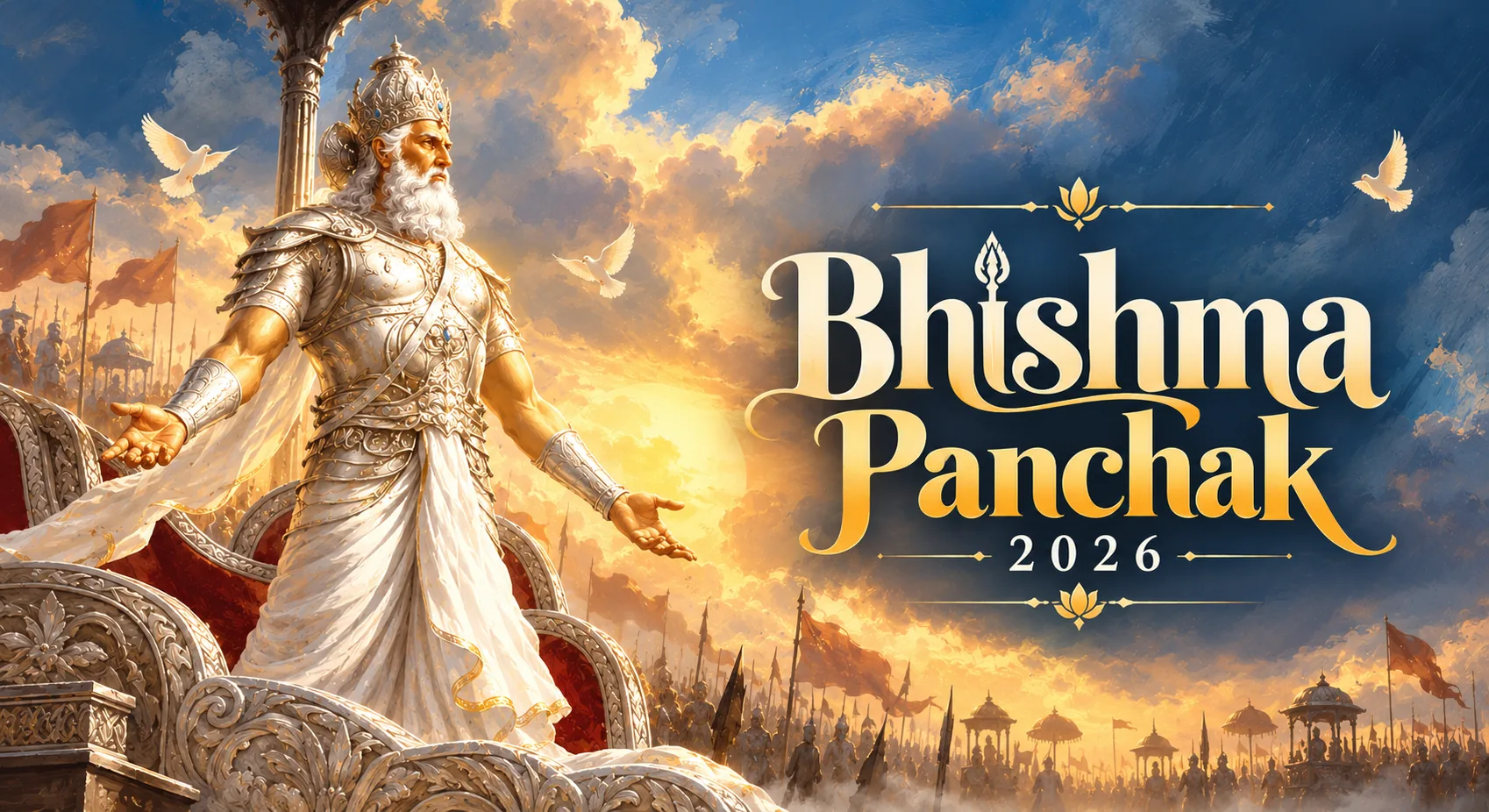
Bhishma Panchak are the last 5 days of the sacred Kartik month, traditionally associated with grandfather Bhishma. Devotees observe a five-day vrat, accepting voluntary austerity and increasing their spiritual practices to please the Lord. This guide explains the significance of Bhishma Panchak and the fasting rules for observing the five-day vrat.
When Is Bhishma Panchak in 2026?
Bhishma Panchak 2026 begins on November 20 and concludes on November 24.
| Day | Date (2026) | Tithi (Kartik Shukla Paksha) | Remarks |
|---|---|---|---|
| Day 1 | Fri, 20 Nov | Ekadashi | Devutthana (Prabodhini) Ekadashi; the vrat begins |
| Day 2 | Sat, 21 Nov | Dwadashi | Some Vaishnava communities start the vrat on this day |
| Day 3 | Sun, 22 Nov | Trayodashi | |
| Day 4 | Mon, 23 Nov | Chaturdashi | Purnima begins late at night |
| Day 5 | Tue, 24 Nov | Purnima | Kartik Purnima; the vrat ends |
Why Is Bhishma Panchak Associated with Bhishmadeva?
Bhishma Panchak is associated with Bhishmadeva because of the five-day vow he received from Lord Krishna. Panchak refers to a group of five, referring to the days from Kartik Shukla Ekadashi to Purnima.
According to the Skanda Purana, Kartika masa mahatmya, Bhishmadeva taught the Pandavas about religious principles while lying on the bed of arrows. On Kartik Shukla Ekadashi, he requested water, which Arjuna brought with his arrow. Pleased with Bhishmadeva, Lord Krishna declared that observing the five-day vrata and offering devotional service to Him during this period would greatly please Him.
According to Gaudiya Vaishnava tradition, Bhishma Panchak is observed in honour of Bhishmadeva’s deep devotion and surrender to Lord Krishna. Despite all the pain, his attention remained fixed on Lord Krishna. He remembered Krishna as Arjuna’s chariot driver, with dust on His face and His hair scattered on the battlefield. In the final moments, Bhishmadeva fixed his mind and eyes on Krishna and left his body. His example teaches devotees to remember the Lord through every difficulty and ultimately at the time of death.
Spiritual Significance of Bhishma Panchak
Bhishma Panchak is a beautiful opportunity to deepen our devotion to Lord Krishna during the last days of Kartik month. Its significance in the life of a devotee is to please the Lord through sincere service and His remembrance.
1. Strengthen devotion towards the Lord
These days help devotees to get the Lord’s blessings and advance in bhakti. Lord Krishna, pleased with Bhishmadeva, blesses those who sincerely observe this vrat with devotion. The greatest blessing is a stronger loving relationship with the Lord.
2. Purifying the Heart
The Padma Purana glorifies Bhishma Panchak as a vow that destroys sins and brings spiritual merit. One who observes the five days with great determination has his sinful reactions vanish.
3. Learning Steady Remembrance from Bhishmadeva
Bhishmadeva remembered Krishna even while suffering on his bed of arrows. His example teaches us to turn towards the Lord during difficulties. It helps us to understand that remembering Lord Krishna until the end of life is the ultimate goal of life.
4. Developing Self-Control Through Devotion
Restraining from the objects of sense pleasure and living a simple life helps devotees reduce distraction and engage more in the Lord’s service. The vow helps one to become more self-controlled and sincere in bhakti.
5. Completing Kartik with Greater Dedication
Bhishma Panchak helps devotees to follow their Kartik practices with more determination during the last five days. It is an opportunity to remember their commitment to chanting, worship, and service, and carry that devotion into daily life after the month ends.
How to Observe Bhishma Panchak Vrat
Devotees observe one of the three types or levels of vrat on Bhishma Panchak. Hari-bhakti-vilasa recommends observing this five-day vow according to one’s ability, with the Lord’s pleasure as the ultimate goal. Follow the guide below to observe Bhishma Panchak Vrat.
Level 1: Traditional Panchagavya Observance
Panchagavya observance is the most difficult type of vow among the three. It involves taking only one specific cow product on each of the first four days and panchagavya (a mixture of cow dung, milk, ghee, urine, and curd) on the last day.
- First day: Cow dung.
- Second day: Cow urine.
- Third day: Cow milk.
- Fourth day: Cow’s curd.
- Fifth day: Panchagavya.
Level 2: Fruits and Roots
Those who cannot follow the first level can observe Bhishma Panchak by taking roots and fruits with one seed, like mango, jamun, avocado, and cherry. While following this vow, milk and milk products are restricted.
- Fruits that meet the prescribed restrictions.
- Boiled or baked potatoes, sweet potatoes, and raw bananas.
- Plain cashews, raisins, and dates.
- Coconut water and grated coconut.
Level 3: Havishya
Havishya refers to the items that are considered pure and fit for offering as an oblation during a fire sacrifice. Those who are unable to observe the above two types of vrat may take havishya. Unlike the second level, this option includes cow’s milk and ghee among its permitted ingredients.
- Atap rice, wheat, cow’s milk, cow’s ghee, and certain fruits and roots.
- Avoid oil, mung dal, cumin, radish, and tamarind.
- Avoid grains and beans on Ekadashi, even though grains may be permitted on the remaining days under this option.
Conclusion
Thus, any sincere devotee can observe Bhishma Panchak vrat as per one’s ability. Whether it may be Panchagavya observance, Fruits and Roots, or Havishya, any of the three will make him advance in bhakti and strengthen loving relationship with Lord Krishna.
Share this article
Help spread the joy and devotion of Janmashtami with others.